Export & Bulk Gold Jewelry Orders from Dubai | Guide for International Retailers

Dubai has established itself as one of the world's leading centres for gold trading, jewellery manufacturing, and international exports. For retailers seeking reliable supply chains, competitive pricing, and high-quality production, bulk orders with Dubai gold factories have become an increasingly attractive sourcing solution.
Whether you operate an independent jewellery store, a retail chain, an online jewellery brand, or a distribution business, sourcing directly from a gold jewelry manufacturer Dubai offers access to extensive product ranges, customisation opportunities, and factory-level pricing. The city's strategic location, well-developed logistics network, and strong regulatory framework further support efficient international trade.
Today, retailers from Europe, North America, Africa, Asia, and the Middle East regularly buy gold jewelry from Dubai factory partners to strengthen inventory, improve margins, and secure dependable production capacity.
This guide explains how international buyers source gold jewellery from Dubai, how export procedures work, what documentation is required, and how to evaluate suppliers before placing large-scale orders.
Why International Retailers Source Gold Jewelry from Dubai
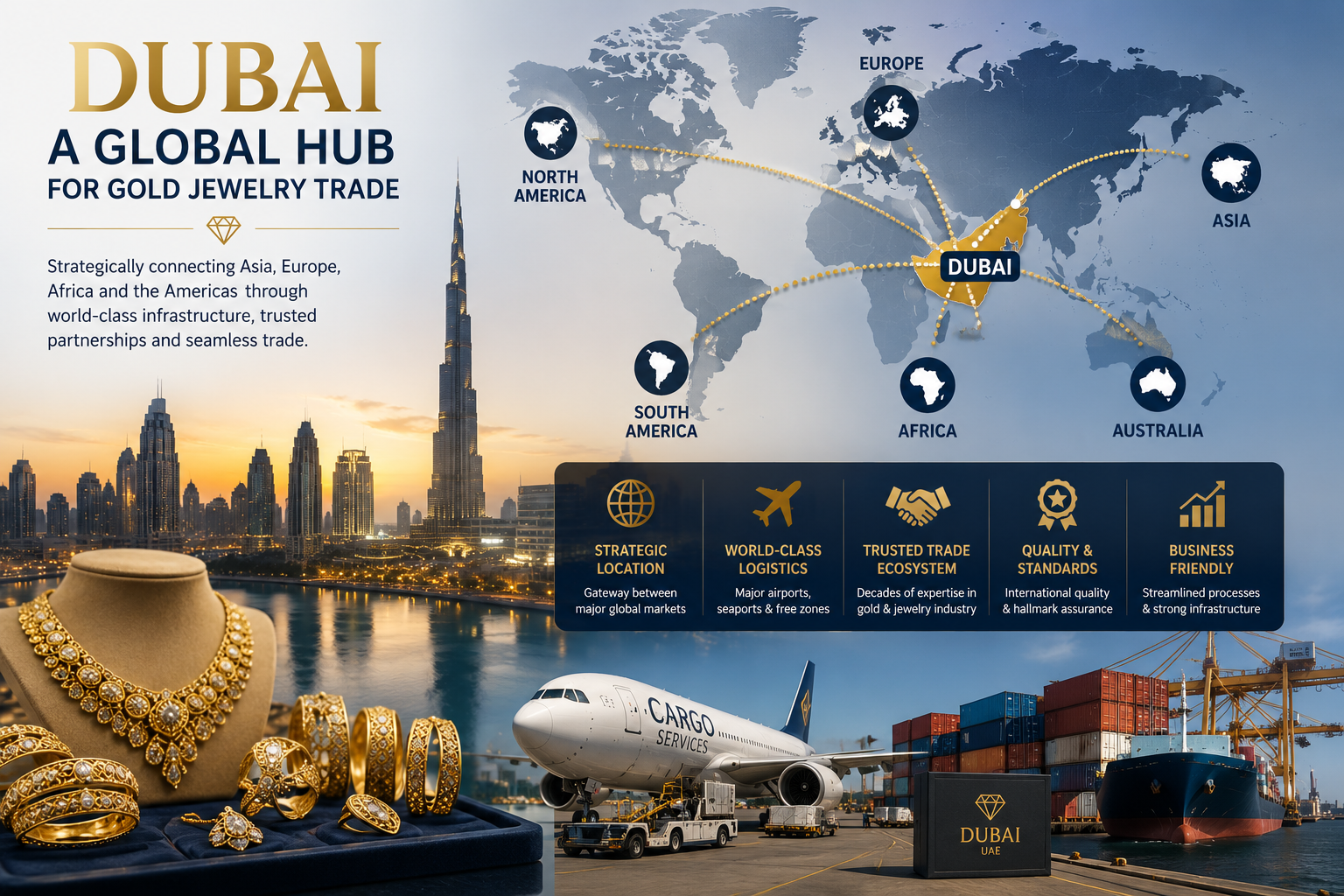
Dubai's reputation as a global jewellery hub is built on a combination of manufacturing expertise, international connectivity, and access to precious metals markets.
Global Trade Hub
Dubai sits at the crossroads of Europe, Asia, and Africa, making it one of the world's most strategically positioned trading centres. International retailers benefit from shorter transit times, extensive air cargo routes, and direct shipping connections to major global markets.
The city's long-standing role in precious metals trading has also created an environment where manufacturers, refiners, gemstone suppliers, logistics providers, and export specialists operate within a highly integrated ecosystem.
Tax Advantages
One reason many businesses explore gold jewelry export Dubai opportunities is the favourable commercial environment. Dubai's business infrastructure supports international trade through streamlined customs processes, free zones, and export-oriented regulations that help facilitate cross-border transactions.
While import duties in destination countries still apply, buyers often find that sourcing from Dubai creates operational efficiencies that support competitive wholesale pricing.
Manufacturing Ecosystem
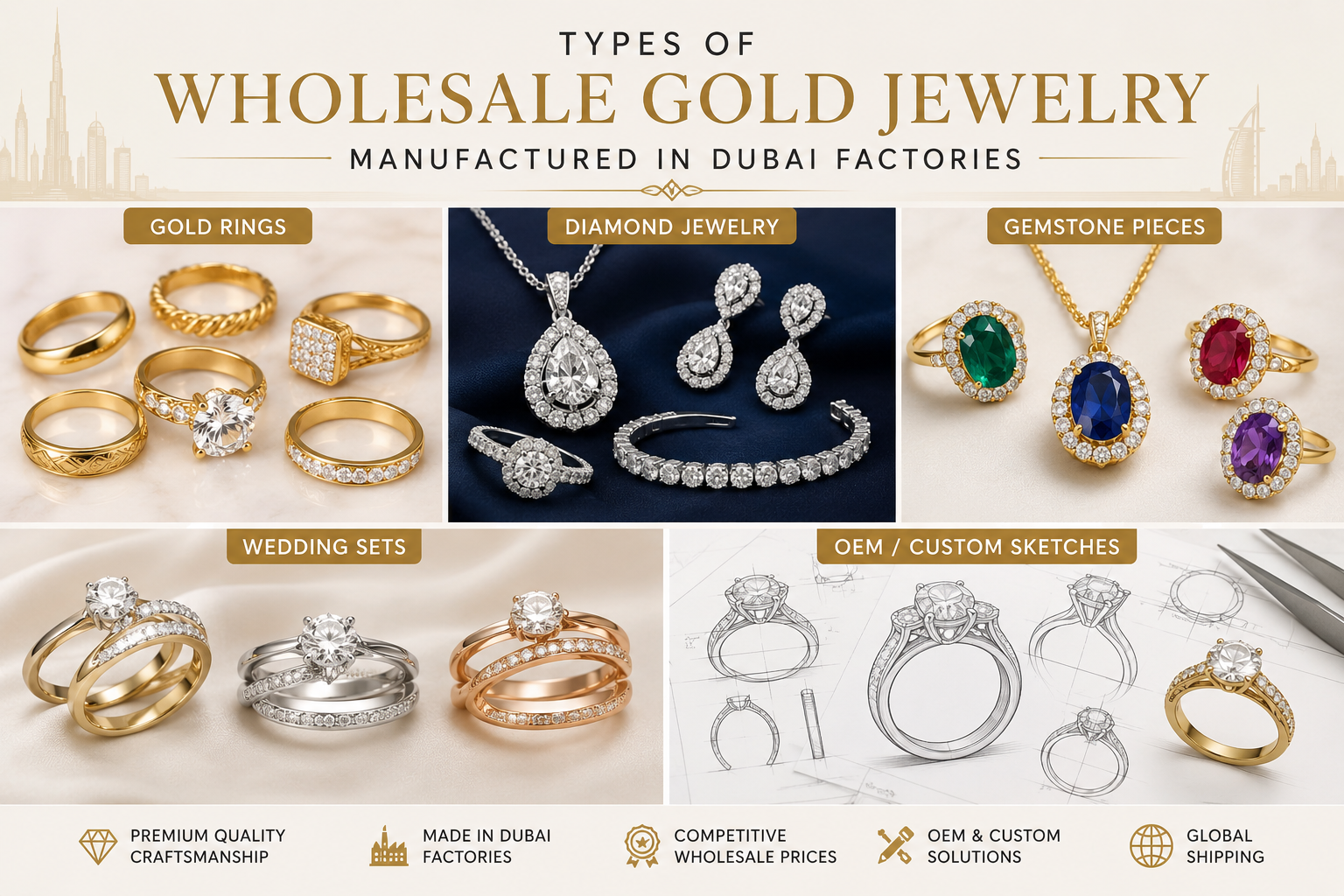
The jewellery manufacturing sector in Dubai includes factories specialising in:
· Gold jewellery production
· Diamond jewellery manufacturing
· Custom jewellery development
· OEM manufacturing
· Private label jewellery
· Large-volume wholesale production
This ecosystem enables international buyers to source multiple product categories through a single supply network.
Gold Purity Standards
Dubai is recognised for its strong emphasis on precious metal quality standards. Manufacturers commonly produce jewellery in:
· 18K gold
· 21K gold
· 22K gold
· Custom alloy specifications
Many factories also provide hallmarking and quality documentation to support international trade requirements.
Logistics Infrastructure
Dubai International Airport and major seaports provide extensive logistics capabilities for global shipments. International buyers benefit from access to specialised carriers experienced in transporting high-value jewellery products securely and efficiently.
These advantages explain why retailers across different market segments increasingly consider Dubai as a long-term sourcing destination. Understanding who these buyers are helps illustrate how diverse international jewellery demand has become.
Types of International Buyers We Work With
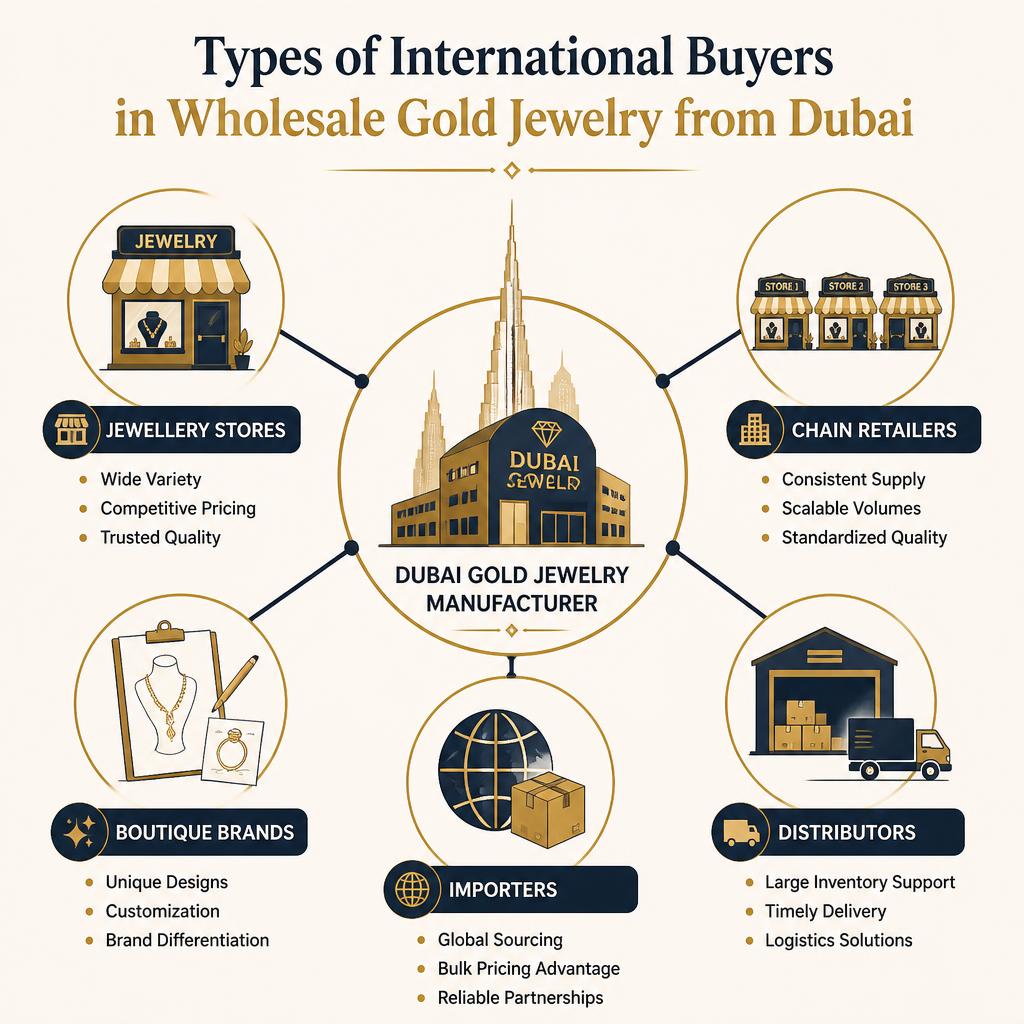
Different buyer categories have unique sourcing objectives, inventory requirements, and growth strategies. Understanding these customer personas helps explain why Dubai has become such a significant wholesale jewellery sourcing destination.
Jewellery Stores
Independent jewellery retailers often seek dependable suppliers capable of providing:
· Consistent quality
· Competitive wholesale pricing
· Flexible order quantities
· Regular inventory replenishment
Many stores buy wholesale gold jewelry from manufacturer partners to improve profitability while maintaining product quality.
Chain Retailers
Multi-location jewellery retailers require large-scale production capabilities and standardised quality across all branches.
Their priorities often include:
· Production consistency
· Reliable lead times
· Volume discounts
· Inventory planning support
Dubai factories frequently support these requirements through structured manufacturing processes and scalable production capacity.
Boutique Brands
Emerging jewellery brands increasingly work directly with manufacturers to create distinctive collections.
These buyers often seek:
· Custom designs
· Private label manufacturing
· Brand-exclusive collections
· Packaging customisation
Working directly with manufacturers allows boutique brands to build stronger market differentiation.
Importers
Importers focus on sourcing products for resale within their domestic markets.
Their priorities include:
· Export compliance
· Competitive pricing
· Product diversity
· Shipping efficiency
Dubai's export-oriented ecosystem supports these objectives through established international trade processes.
Distributors
Regional distributors typically manage inventory across multiple retailers and require substantial production volumes.
They often prioritise:
· Large order fulfilment
· Long-term supply agreements
· Consistent manufacturing standards
· Broad product portfolios
Regardless of buyer category, the actual ordering process follows a structured workflow that minimises risk and improves efficiency.
How Bulk Gold Jewelry Orders from Dubai Work
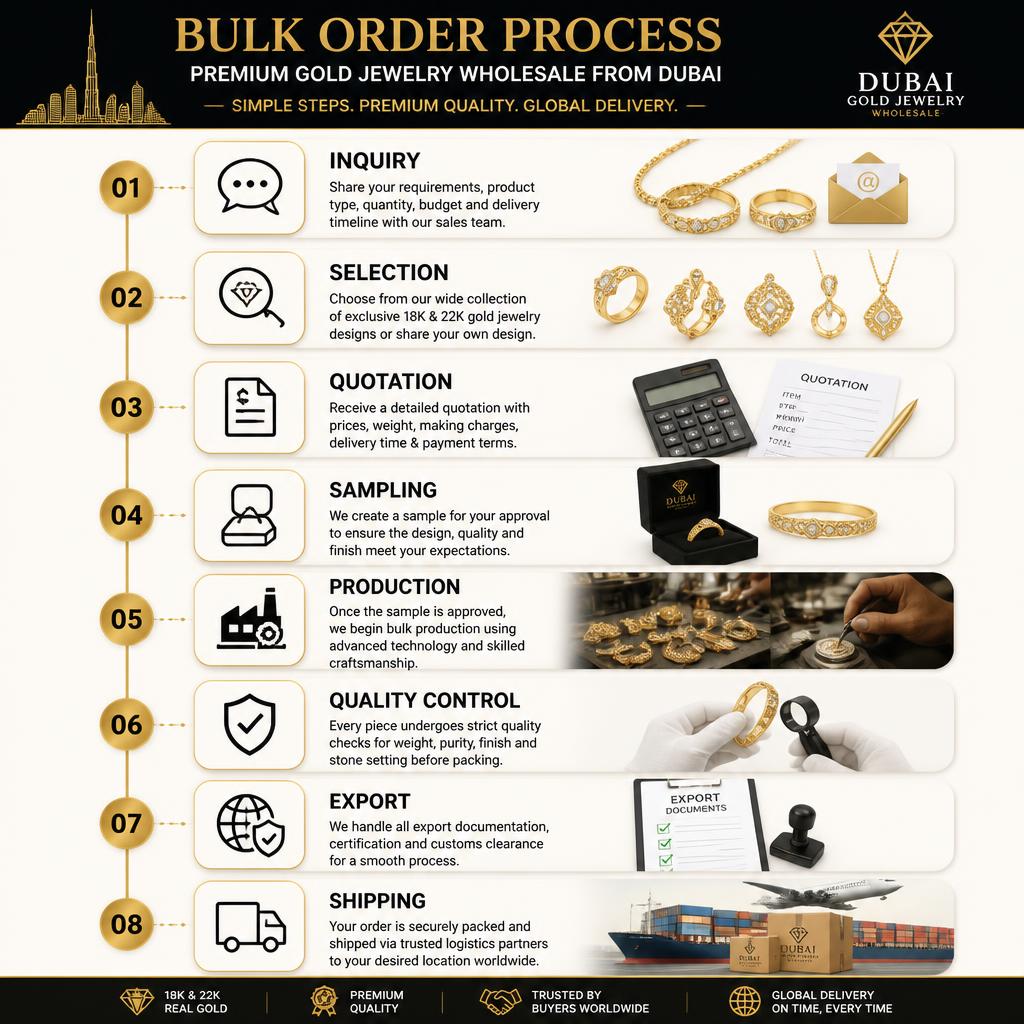
Understanding the ordering process is critical for international retailers placing bulk jewelry orders Dubai suppliers produce for global markets.
Step 1: Inquiry
The process begins with an initial enquiry.
This stage establishes the foundation for the entire project.
Professional buyers typically provide information regarding:
· Product categories
· Gold purity requirements
· Quantity expectations
· Target markets
· Design preferences
· Budget ranges
· Delivery schedules
· Packaging requirements
The more detailed the enquiry, the easier it becomes for manufacturers to provide accurate recommendations and quotations.
Retailers that submit incomplete information often receive less precise pricing and production estimates, which can create complications later.
Step 2: Product Selection
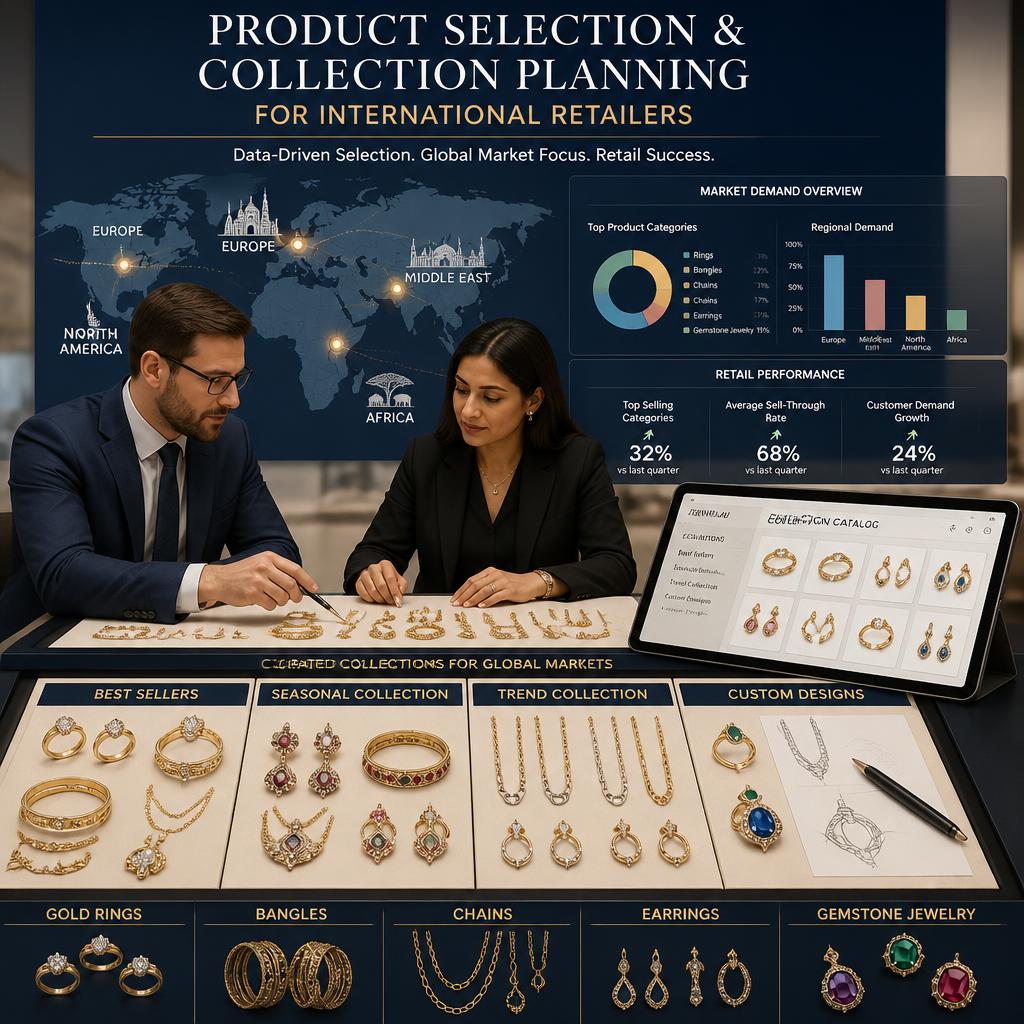
Once the enquiry has been reviewed, buyers move to the product selection phase.
Depending on the supplier, options may include:
- Existing catalogue collections
- Best-selling designs
- Seasonal collections
- Trend-focused products
- Custom-developed pieces
Professional manufacturers often assist buyers by recommending products based on market demand and regional preferences.
For example, customer preferences in Europe may differ significantly from those in the Middle East, Africa, or North America. Understanding these differences helps buyers select collections that align with local purchasing behaviour.
Product selection is also an important stage for evaluating profit potential. Buyers should consider expected retail pricing, inventory turnover, customer demographics, and long-term demand when building product assortments.
Step 3: Quotation
Following product selection, the manufacturer prepares a quotation.
A professional quotation should clearly outline:
- Product specifications
- Gold purity
- Approximate weight
- Stone details
- Unit pricing
- Production costs
- Minimum order quantities
- Lead times
- Packaging costs
- Shipping estimates
- Payment terms
Many inexperienced buyers focus exclusively on unit price.
However, successful retailers evaluate quotations more comprehensively by considering quality standards, production reliability, supplier expertise, and long-term partnership potential.
A lower price does not necessarily represent better value if production quality or delivery performance suffers.
Step 4: Sampling
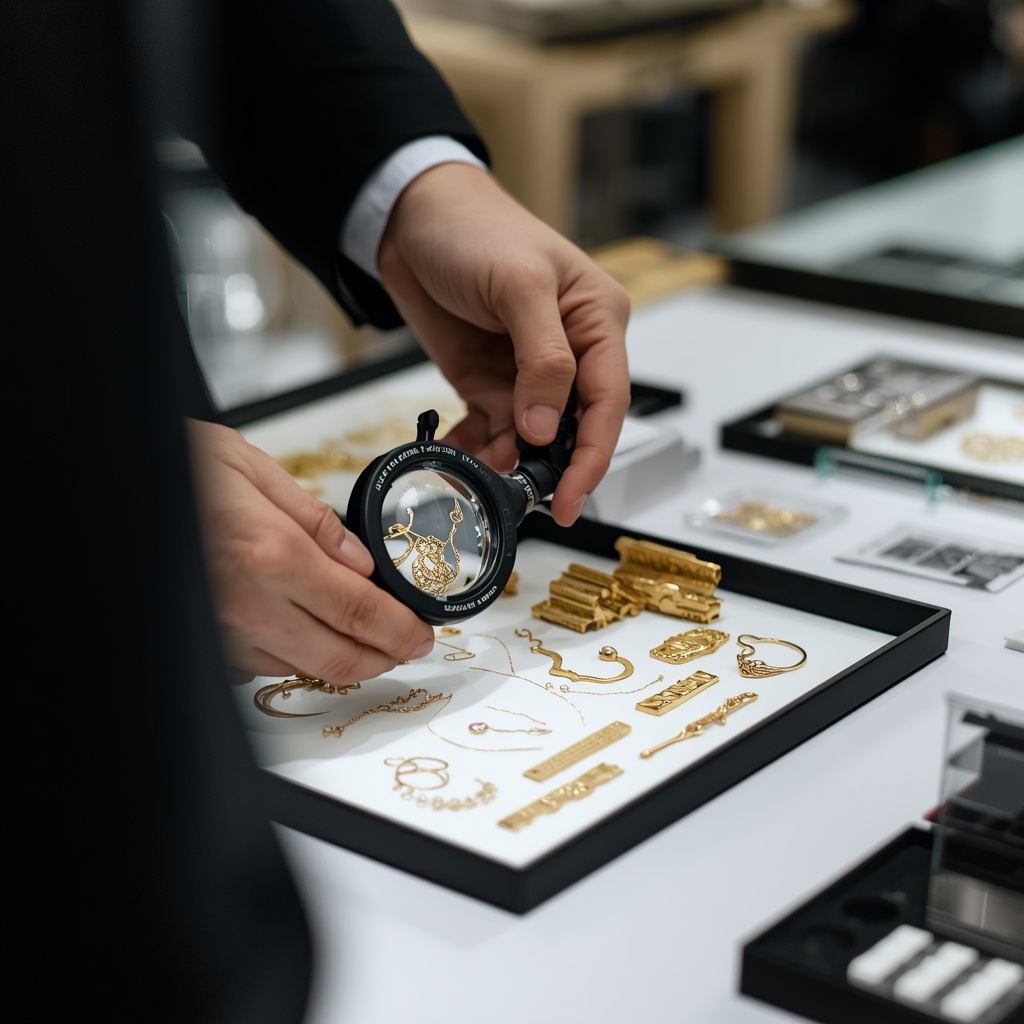
Sampling is one of the most important stages in the international jewellery sourcing process. Regardless of how impressive a product catalogue may appear, retailers should always evaluate physical samples before committing to large-scale production.
A sample allows buyers to verify that the finished product meets their expectations regarding design, craftsmanship, materials, and overall quality.
Samples allow buyers to assess:
· Design accuracy
· Gold finishing quality
· Product dimensions
· Weight consistency
· Stone-setting quality
· Wear ability
· Packaging standards
Many successful retailers treat sampling as a risk-management tool rather than an additional cost.
What Buyers Should Evaluate
When reviewing samples, retailers should inspect:
a) Craftsmanship
Examine soldering, polishing, finishing, and overall construction quality.
b) Stone Setting
Check that stones are secure, properly aligned, and free from visible defects.
c) Weight Accuracy
Confirm that product weights align with quotation specifications.
d) Comfort and Wear ability
Products should not only look attractive but also provide a comfortable customer experience.
e) Packaging Presentation
Packaging can significantly influence perceived value and customer satisfaction.
Professional manufacturers welcome detailed sample reviews because clear feedback helps ensure production accuracy during later stages.
Once samples receive formal approval, production can begin with greater confidence.
Step 5: Production
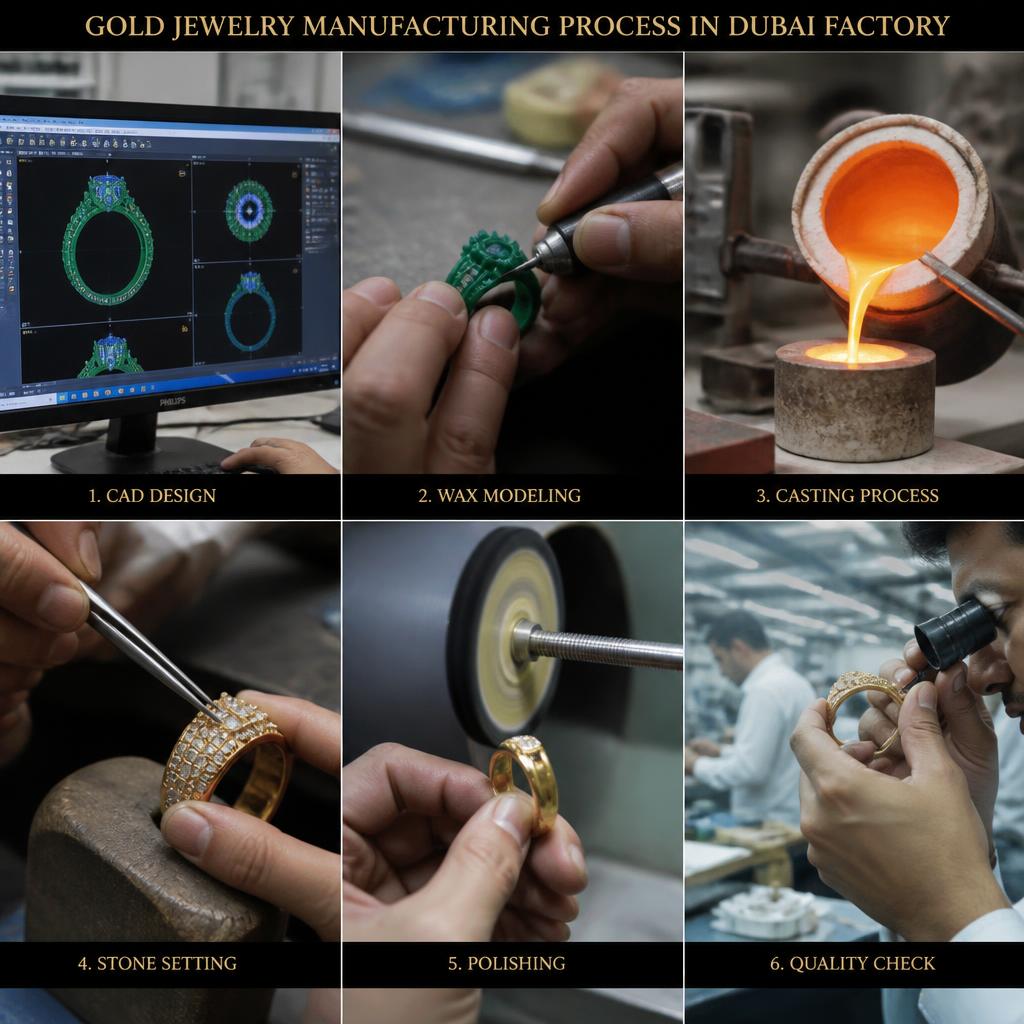
Once samples receive approval, manufacturing begins. Professional factories implement structured production processes involving:
· Design Preparation
Before manufacturing begins, factories typically finalise technical documentation. This may include:
a) CAD files
b) Technical drawings
c) Production specifications
d) Material requirements
e) Quality standards
Accurate documentation helps ensure consistency throughout production.
· Casting
Casting forms the foundation of many jewellery manufacturing processes. This stage involves:
a) Alloy preparation
b) Wax model production
c) Mould creation
d) Metal casting
e) Initial cleaning
Precision during casting is critical because defects at this stage can affect the entire production run.
· Assembly
Following casting, jewellery components are assembled. This may involve:
a) Soldering
b) Component joining
c) Structural adjustments
d) Pre-finishing preparation
Professional assembly procedures contribute significantly to durability and long-term product performance.
· Stone setting
For gemstone jewellery, stone setting represents one of the most specialised manufacturing stages. Experienced setters carefully secure gemstones using appropriate techniques designed to balance aesthetics and durability.
Factors evaluated during this process include:
a) Stone alignment
b) Security
c) Symmetry
d) Visual presentation
· Polishing and finishing
Processes may include:
a) Polishing
b) Surface treatment
c) Texture creation
d) Rhodium plating
e) Final aesthetic enhancement
The quality of finishing often has a direct impact on customer perception and retail presentation.
Step 6: Quality Check
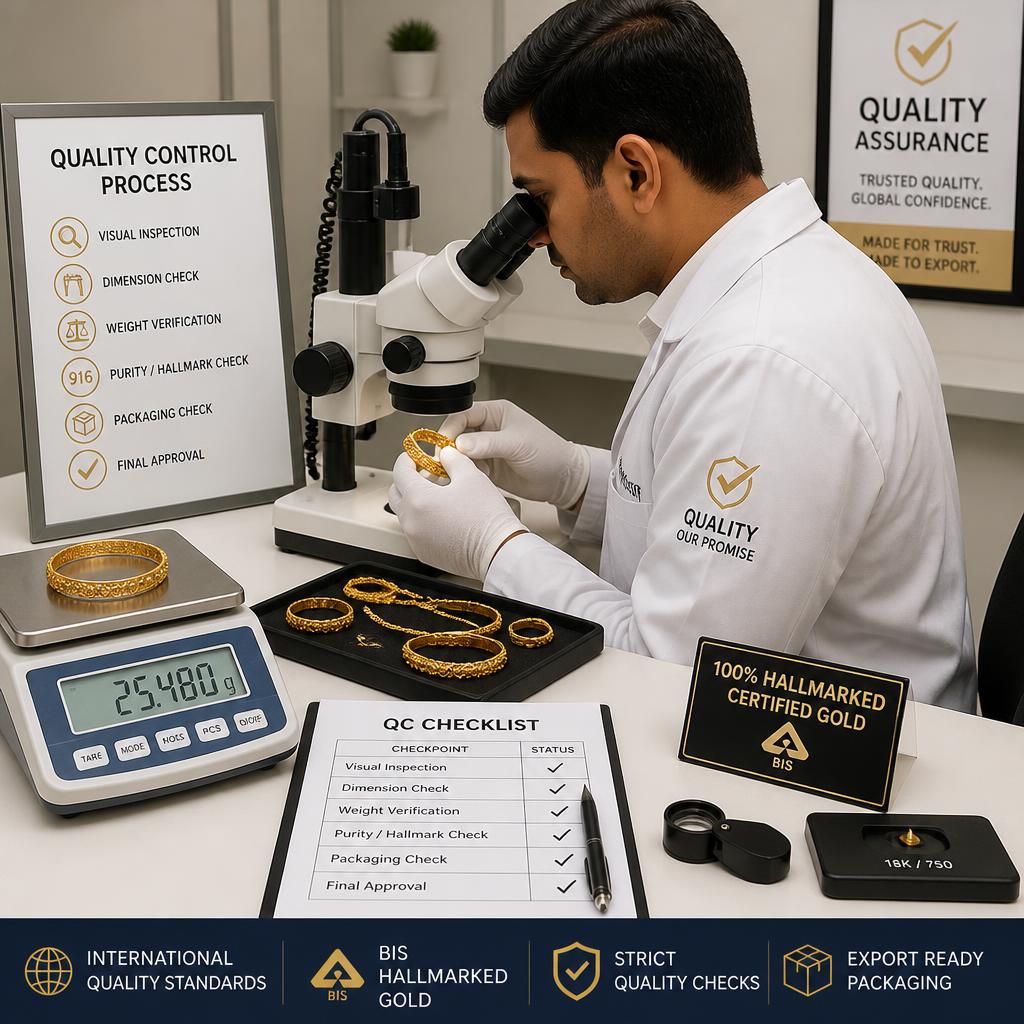
Quality control is among the most important elements of successful jewellery manufacturing. Reliable factories implement multiple inspection stages before products are approved for export.
· Metal Verification
Inspectors verify:
a) Gold purity
b) Weight accuracy
c) Alloy consistency
This helps ensure products match approved specifications.
· Stone Inspection
For gemstone jewellery, inspectors evaluate:
a) Stone quality
b) Placement accuracy
c) Setting security
d) Surface condition
· Finishing Evaluation
Surface quality inspections typically assess:
a) Polish consistency
b) Scratches
c) Surface defects
d) Colour uniformity
e) Dimensional Accuracy
Measurements are checked against approved specifications to ensure consistency across production batches.
· Packaging Inspection
Before shipment, packaging materials are reviewed to confirm:
a) Product protection
b) Branding requirements
c) Labelling accuracy
Strong quality-control procedures help reduce returns, complaints, and reputational risks.
Step 7: Export Documentation
Following production approval, manufacturers prepare export documentation.
Accurate documentation is essential because customs authorities depend on these records when processing international shipments.
Preparing documentation correctly at this stage helps prevent costly delays later in the logistics process.
Step 8:Shipping
Once production and documentation are complete, orders move to shipment.
Depending on the destination and order value, retailers may select courier services, specialised logistics providers, or airfreight solutions.
Shipment tracking and communication remain important throughout transit to ensure buyers maintain visibility until final delivery.
At this point, the manufacturing process is complete, but successful international trade also depends heavily on documentation compliance.
Export Documentation & Compliance Requirements
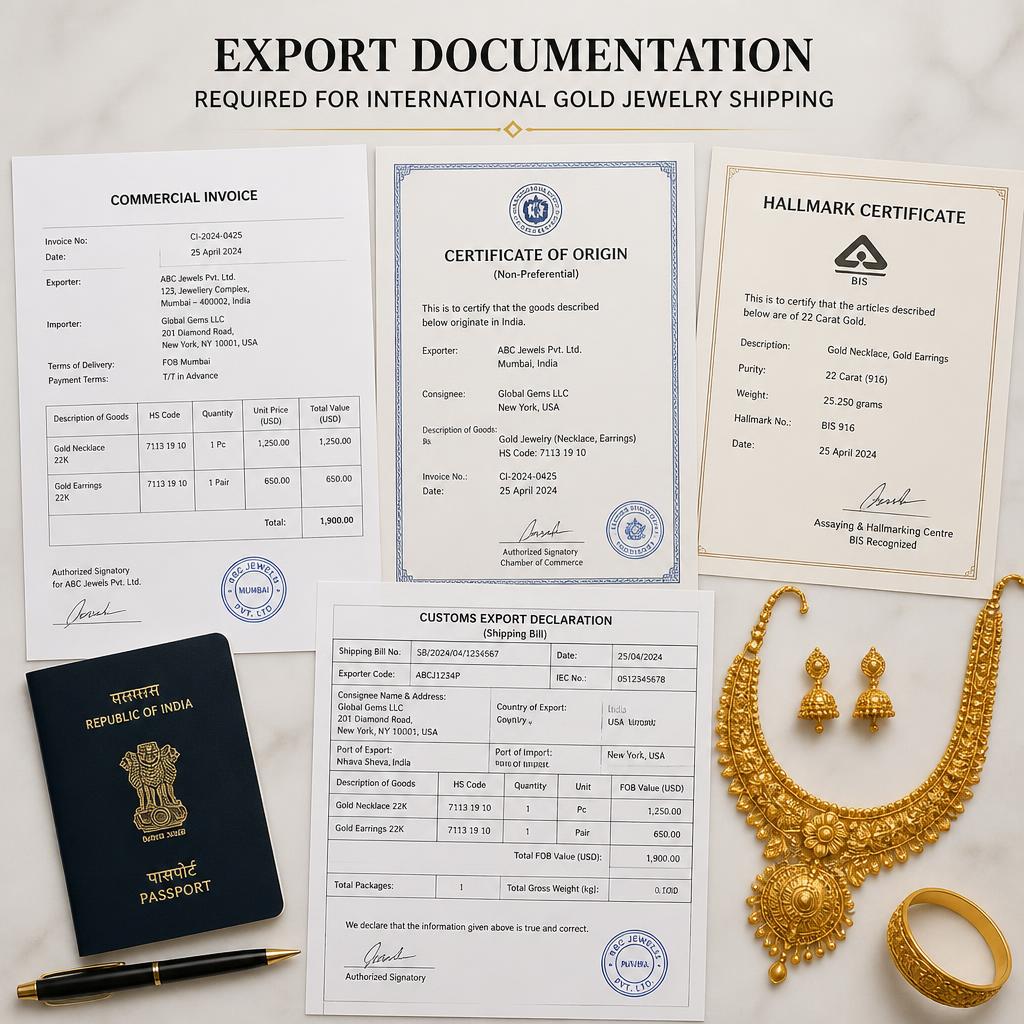
Export documentation forms the foundation of international jewellery trade. Even high-quality products can encounter delays if supporting paperwork is incomplete or inaccurate.
Commercial Invoice
The commercial invoice is one of the most important export documents.
It typically includes:
- Seller information
- Buyer information
- Product descriptions
- Quantities
- Unit values
- Total shipment value
- Currency information
- Terms of sale
Customs authorities use this document to assess duties, taxes, and shipment classification.
Accuracy is essential because errors can result in delays or additional inspections.
Certificate of Origin
Many countries require a Certificate of Origin as part of the import process.
This document confirms the country where the products were manufactured and may influence customs treatment depending on applicable trade agreements.
Importers should verify destination-country requirements before shipment.
Hallmark Documentation
Because gold jewellery involves precious metals, some jurisdictions require evidence supporting purity claims.
Hallmark-related documentation may include:
- Metal purity information
- Testing records
- Certification details
- Quality verification records
Providing supporting documentation helps strengthen buyer confidence and supports regulatory compliance.
Customs Documentation
Additional customs paperwork may include:
- Export declarations
- Product classification details
- Security filings
- Import permits
- Transport documentation
Requirements vary considerably between countries.
Retailers should work closely with suppliers and customs specialists to ensure compliance with local regulations.
Country-Specific Compliance Considerations
International buyers should remember that import regulations differ significantly between markets.
Areas that often vary include:
- Precious metal standards
- Labelling requirements
- Hallmark regulations
- Product safety requirements
- Documentation obligations
Understanding these requirements before placing orders helps reduce the risk of customs complications.
Proper documentation prepares products for international shipment, but choosing the right logistics solution is equally important.
Shipping Options for International Jewelry Orders
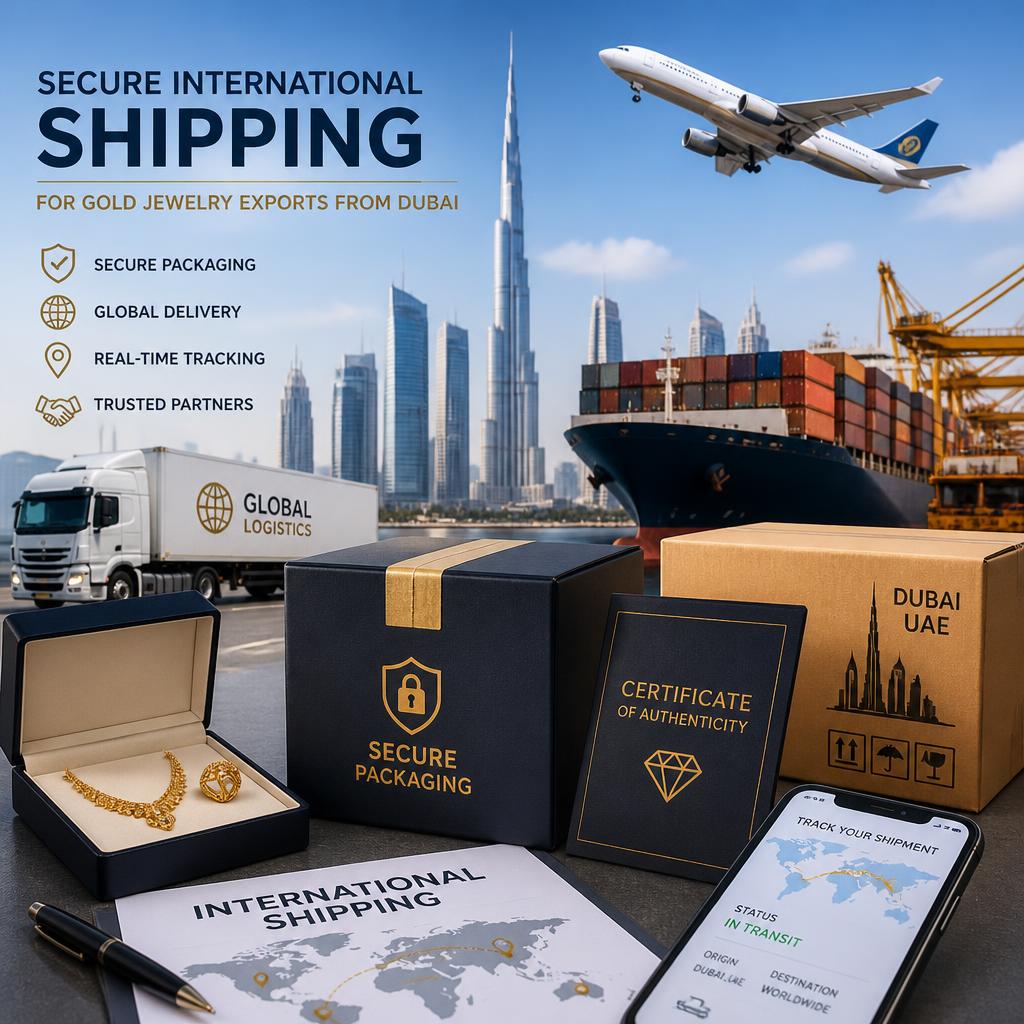
Shipping jewellery internationally requires balancing speed, security, cost, and reliability.
The most suitable shipping solution depends on shipment value, urgency, destination, and volume.
DHL
DHL remains one of the most commonly used international courier services for jewellery exports.
Advantages include:
- Global reach
- Reliable tracking
- Customs support
- Fast delivery times
Many retailers use DHL for small and medium-sized wholesale shipments.
FedEx
FedEx is another popular option for international jewellery transportation.
Benefits include:
- International express delivery
- Strong logistics infrastructure
- Shipment visibility
- Customs expertise
Businesses often select FedEx when delivery speed is a priority.
Armoured Logistics
High-value jewellery shipments may require specialised security solutions.
Armoured logistics providers offer:
- Enhanced transport security
- Controlled handling procedures
- Risk management protocols
- Secure storage capabilities
These services are commonly used for substantial commercial orders involving significant product value.
Air Freight
Air freight remains one of the most efficient methods for transporting larger jewellery consignments internationally.
Benefits include:
- Faster transit times
- Reduced handling exposure
- Global connectivity
- Improved inventory planning
Many distributors and chain retailers prefer air freight because it balances efficiency and scalability.
While logistics networks are highly developed, international buyers still encounter various sourcing challenges that require proactive management.
Common Challenges International Buyers Face
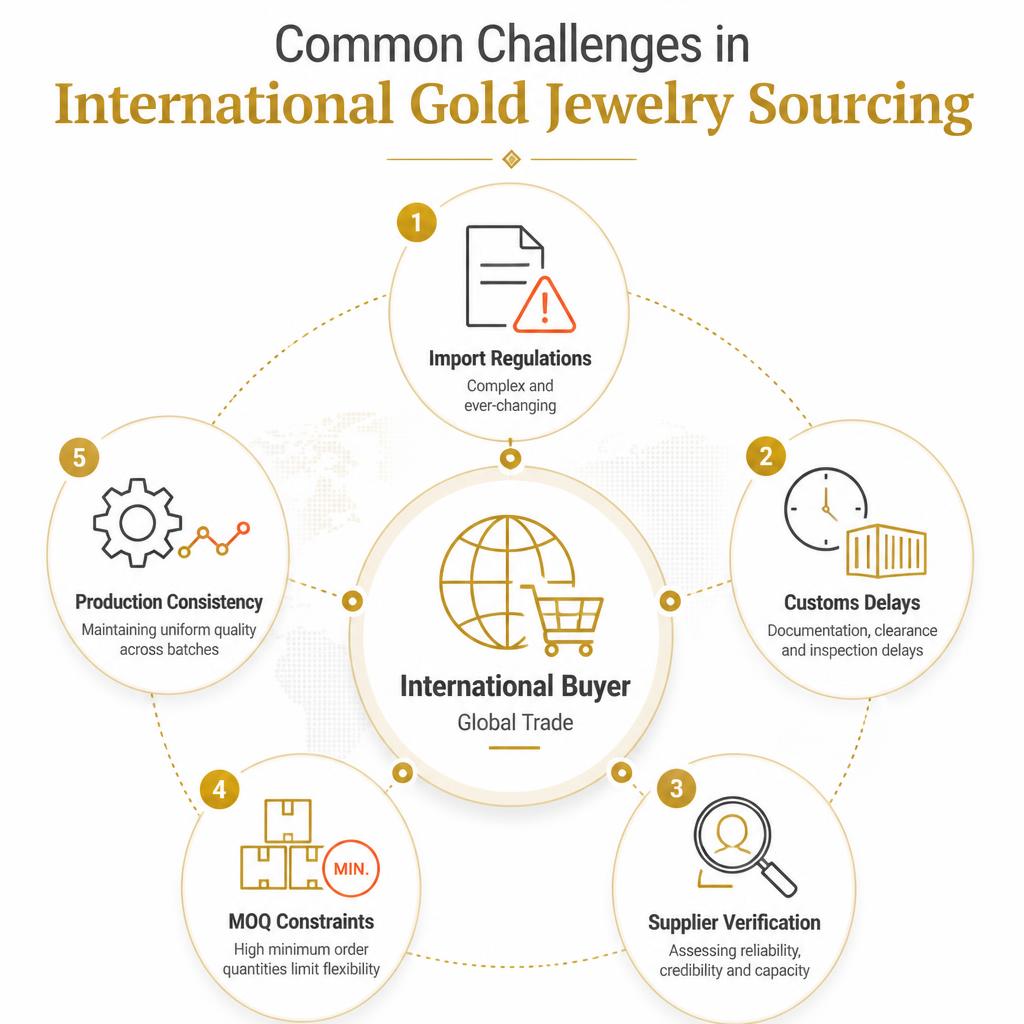
Cross-border jewellery sourcing offers significant opportunities but also introduces operational risks.
Understanding these challenges helps retailers make more informed purchasing decisions.
Import Regulations
Every market maintains unique rules regarding precious metals and jewellery imports.
Potential requirements may involve:
- Hallmark standards
- Product labelling
- Metal purity regulations
- Customs declarations
Failure to comply can result in delays, penalties, or shipment rejection.
Delayed Customs Clearance
Customs delays can occur for several reasons.
Common causes include:
- Missing documents
- Classification errors
- Incorrect valuations
- Regulatory reviews
- Inspection requirements
Working with experienced exporters often helps minimise these risks.
Supplier Verification Challenges
One of the most significant concerns for international buyers involves identifying trustworthy suppliers.
Potential risks include:
- Misrepresented capabilities
- Inconsistent quality
- Poor communication
- Limited export experience
Comprehensive due diligence helps mitigate these concerns.
MOQ Issues
Minimum order quantities can create challenges, particularly for growing retailers.
High MOQs may affect:
- Cash flow
- Inventory turnover
- Product testing initiatives
- Market-entry strategies
Buyers should evaluate MOQ requirements carefully before committing to supplier relationships.
Production Consistency
Some suppliers perform well on initial orders but struggle to maintain quality across repeat production runs.
Retailers should assess production consistency, quality-control systems, and operational maturity before establishing long-term partnerships.
Many of these challenges can be reduced by working directly with manufacturers rather than intermediaries, which explains a growing trend within international jewellery sourcing.
Why Retailers Buy Directly from Manufacturers Instead of Traders
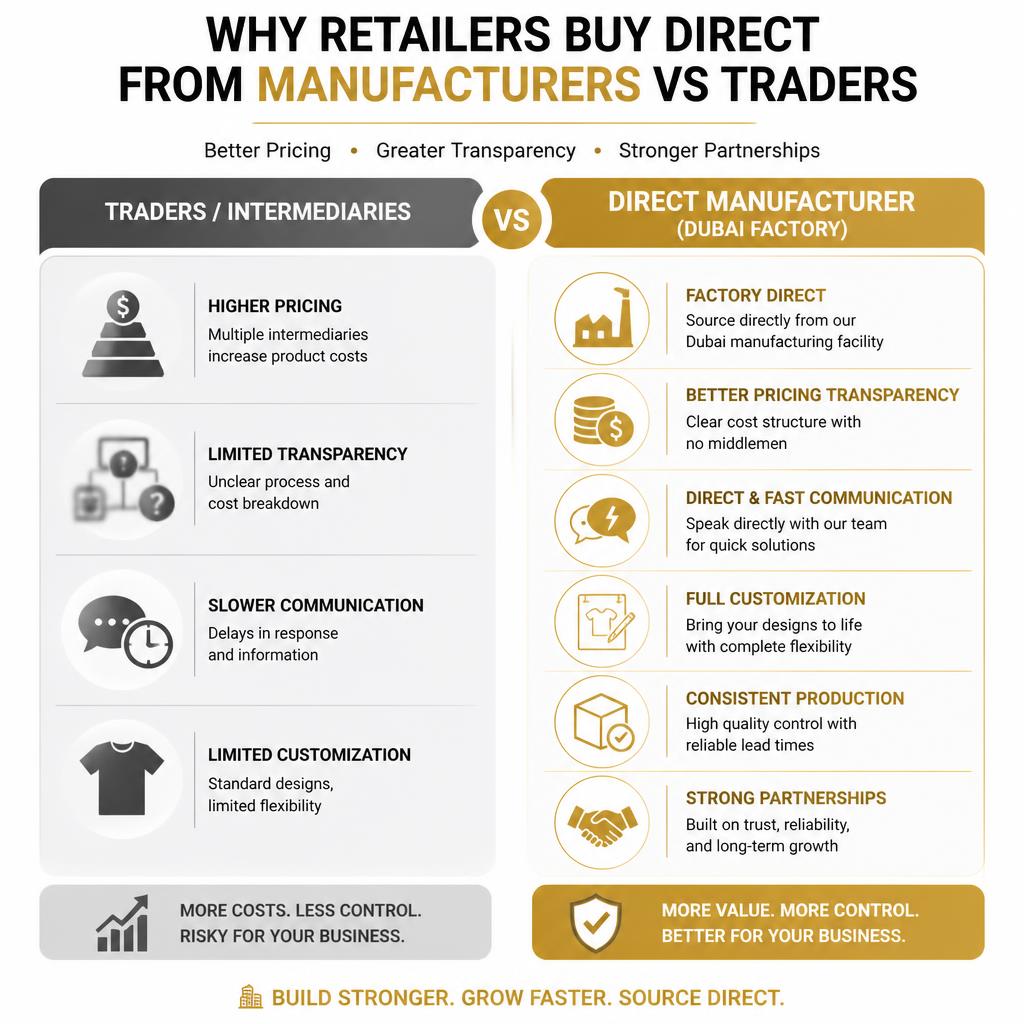
Over the past decade, many international retailers have shifted away from sourcing through trading companies and have instead chosen to establish direct relationships with manufacturers. While traders can provide convenience in some situations, working directly with a manufacturer often delivers greater transparency, stronger communication, and improved long-term value.
For retailers placing bulk jewelry orders Dubai suppliers produce for international markets, direct factory relationships can become a significant competitive advantage.
Better Pricing Transparency
One of the primary reasons retailers prefer direct sourcing is pricing transparency.
When buyers work directly with a manufacturer, they gain a clearer understanding of the factors influencing product costs, including:
· Gold weight
· Gold purity
· Labour costs
· Stone specifications
· Manufacturing complexity
· Packaging requirements
This visibility allows businesses to make more informed purchasing decisions and improve margin planning.
By contrast, traders often add intermediary mark-ups that can increase overall procurement costs.
Improved Communication
Communication is a critical component of successful international sourcing. Direct access to manufacturing teams allows retailers to discuss:
· Design modifications
· Production schedules
· Quality requirements
· Packaging specifications
· Inventory planning
This direct communication often reduces misunderstandings and enables faster decision-making throughout the production cycle.
Greater Customisation Opportunities
Retailers increasingly seek product differentiation in competitive markets. Direct factory relationships make it easier to develop:
· Exclusive collections
· Private label products
· Custom packaging
· Market-specific designs
· Brand-focused product lines
For boutique brands and growing retailers, this flexibility can help strengthen market positioning and customer loyalty.
Better Quality Control Oversight
Quality control becomes easier to manage when buyers work directly with production facilities.
Retailers can discuss:
· Inspection procedures
· Material specifications
· Testing requirements
· Production standards
Greater visibility into quality-control processes often contributes to more consistent outcomes across repeat orders.
Stronger Long-Term Partnerships
Successful wholesale relationships are often built over many years. Direct factory partnerships create opportunities for:
· Better forecasting
· Priority production scheduling
· Improved pricing structures
· Greater operational efficiency
· Enhanced product development collaboration
Many retailers eventually view their manufacturing partner as a strategic extension of their business rather than simply a supplier.
Before establishing such partnerships, however, buyers should conduct thorough Supplier verification is one of the most important steps in international jewellery sourcing. Thorough due diligence helps retailers avoid costly mistakes and identify manufacturers capable of supporting long-term business growth.
How to Verify a Dubai Jewelry Supplier Before Ordering
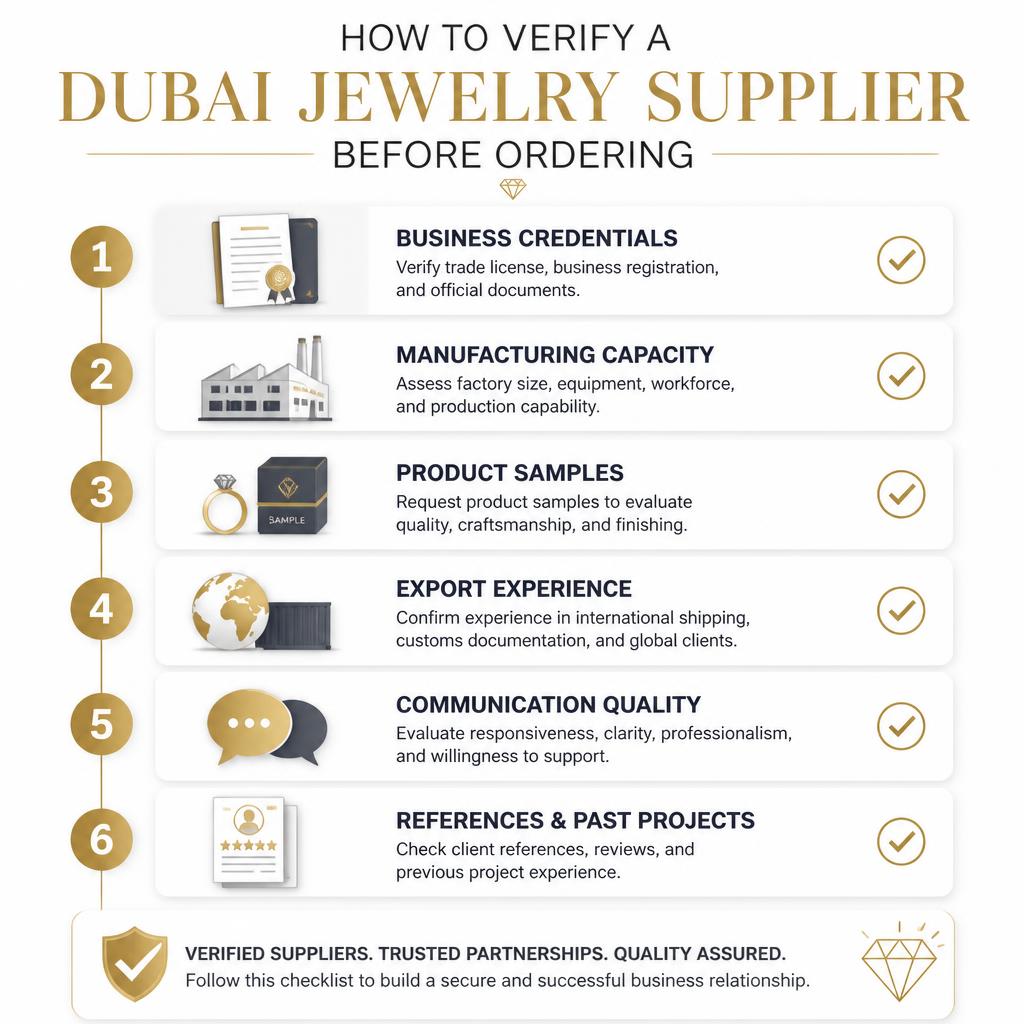
Review Business Credentials
Verify:
· Business registration
· Trading licences
· Export documentation capabilities
· Industry certifications
Legitimate suppliers should willingly provide supporting information.
Evaluate Manufacturing Capacity
Assess:
· Production facilities
· Equipment
· Workforce capabilities
· Scalability
Factories should demonstrate their ability to handle current and future order volumes.
Request Samples
Sample evaluation remains one of the most reliable verification methods.
Inspect:
· Finishing quality
· Structural integrity
· Design accuracy
· Packaging standards
Evaluate Export Experience
Not every manufacturer has extensive experience serving international markets.
Export-focused suppliers should understand:
- International shipping procedures
- Customs requirements
- Documentation standards
- Logistics coordination
Experience in international trade often contributes to smoother order execution.
Assess Communication Quality
Communication quality frequently reflects broader operational standards.
Evaluate:
- Response times
- Professionalism
- Technical knowledge
- Transparency
- Willingness to answer questions
Reliable communication is particularly important when managing large international orders.
Check References and Past Projects
Where possible, request examples of previous projects or customer references.
This can help provide insight into:
- Production consistency
- Delivery reliability
- Customer satisfaction
- Long-term performance
Thorough verification creates a stronger foundation for successful long-term sourcing relationships. Before concluding, many buyers share similar questions regarding international jewellery procurement.
Frequently Asked Questions

Can international retailers buy directly from Dubai jewellery factories?
Yes. Many manufacturers work directly with overseas retailers, distributors, importers, and jewellery brands.
Why do retailers buy gold jewelry from Dubai factory partners?
Retailers often benefit from factory-direct pricing, manufacturing expertise, customisation options, and access to established export processes.
What is the typical MOQ for wholesale gold jewellery?
Minimum order quantities vary depending on product type, manufacturing complexity, and supplier policies.
How long does production usually take?
Lead times depend on order size, customisation requirements, and production schedules. Buyers should confirm timelines during quotation discussions.
Is custom jewellery manufacturing available?
Many Dubai manufacturers provide custom development, OEM production, and private label services for international brands.
What documents are required for gold jewellery exports?
Requirements often include commercial invoices, certificates of origin, hallmark documentation, and customs paperwork. Destination-country regulations may require additional documents.
What shipping method is best for international jewellery orders?
The appropriate method depends on shipment value, urgency, destination, and security requirements. DHL, FedEx, armoured logistics providers, and airfreight services are commonly used.
How are international payments handled?
Payment structures vary between suppliers but often include deposits, milestone payments, or agreed payment terms based on order size and commercial relationships.
Conclusion
Dubai continues to strengthen its position as one of the world's leading destinations for gold jewellery manufacturing and international trade. Its combination of manufacturing expertise, global connectivity, quality standards, and export infrastructure makes it an attractive sourcing destination for retailers across diverse markets.
For businesses seeking reliable inventory, competitive pricing, and long-term supply relationships, working directly with a gold jewelry manufacturer Dubai can provide significant advantages over traditional sourcing models.
Understanding the complete process—from enquiry and sampling through production, quality control, documentation, and shipping—allows retailers to make more informed purchasing decisions and minimise operational risks.
At the same time, supplier verification remains essential. Businesses that carefully evaluate manufacturing capabilities, quality systems, export experience, and communication practices are often better positioned to build successful long-term partnerships.
As international demand for high-quality gold jewellery continues to grow, retailers who establish strong sourcing relationships in Dubai can benefit from dependable manufacturing support, efficient export processes, and scalable wholesale opportunities that support future business expansion.
At Golden Lake, we help international retailers, importers, distributors, and jewellery brands source high-quality gold jewellery with confidence.
From product selection and sample development to manufacturing, quality control, export documentation, and worldwide delivery, our team provides end-to-end support throughout the sourcing process.
Whether you are expanding your product range, launching a private-label collection, or seeking a reliable gold jewelry manufacturer in Dubai, Golden Lake offers the expertise, quality, and export experience needed to support your long-term growth.
Contact Golden Lake today to discuss your requirements and receive a tailored quotation.